Sounding the Reef: An Immersive Art Exhibit to Share Ecosystem Restoration

Reefs reimagined: Art as catalyst in coral conservation

Speaker Intro

Ahoy! I am Océane, a Ph.D. candidate at SIO

  • I study ecoacoustics, which means I listen to ocean sounds to learn about life in the sea.
  • I study how fish, shrimp, and other sea animals use sound to find food, stay safe, and communicate. Sometimes I am a reef fish DJ and play back the sounds of healthy reefs to degraded reefs, helping them recover faster.
  • I also track how reef soundscapes are changing when humans add pressures like noise, warming waters, and habitat damage.
  • My North Star is to help communities and scientists work together to protect healthy ocean habitats for the next generation.

As scientific divers, we deploy our directional hydrophones like the one I am holding at 100 ft deep. This was in the Au'Au channel of Maui where we study humpback whale migrations.

Video credit: Corinne Pickering.
Motivation

Inspired by our acoustic enrichment studies off the windward reefs of O'ahu, Hawai'i ~ we demonstrated enhanced coral recruitment and survival using acoustic enrichment, artificial reef structures, and nanoengineered biofilms.

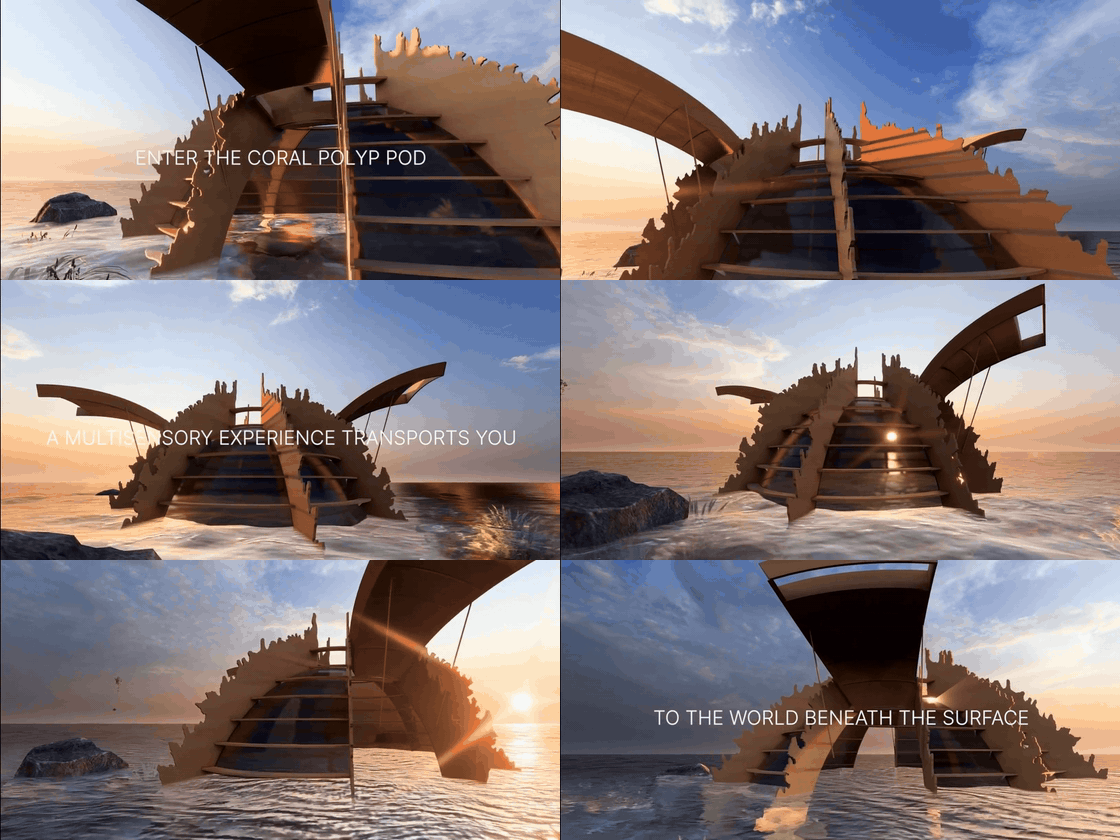
The idea of Polypod was born from these studies, serving as a spatial and interactive installation to convey the acoustic environment of coral reefs from the "larvae perspective"

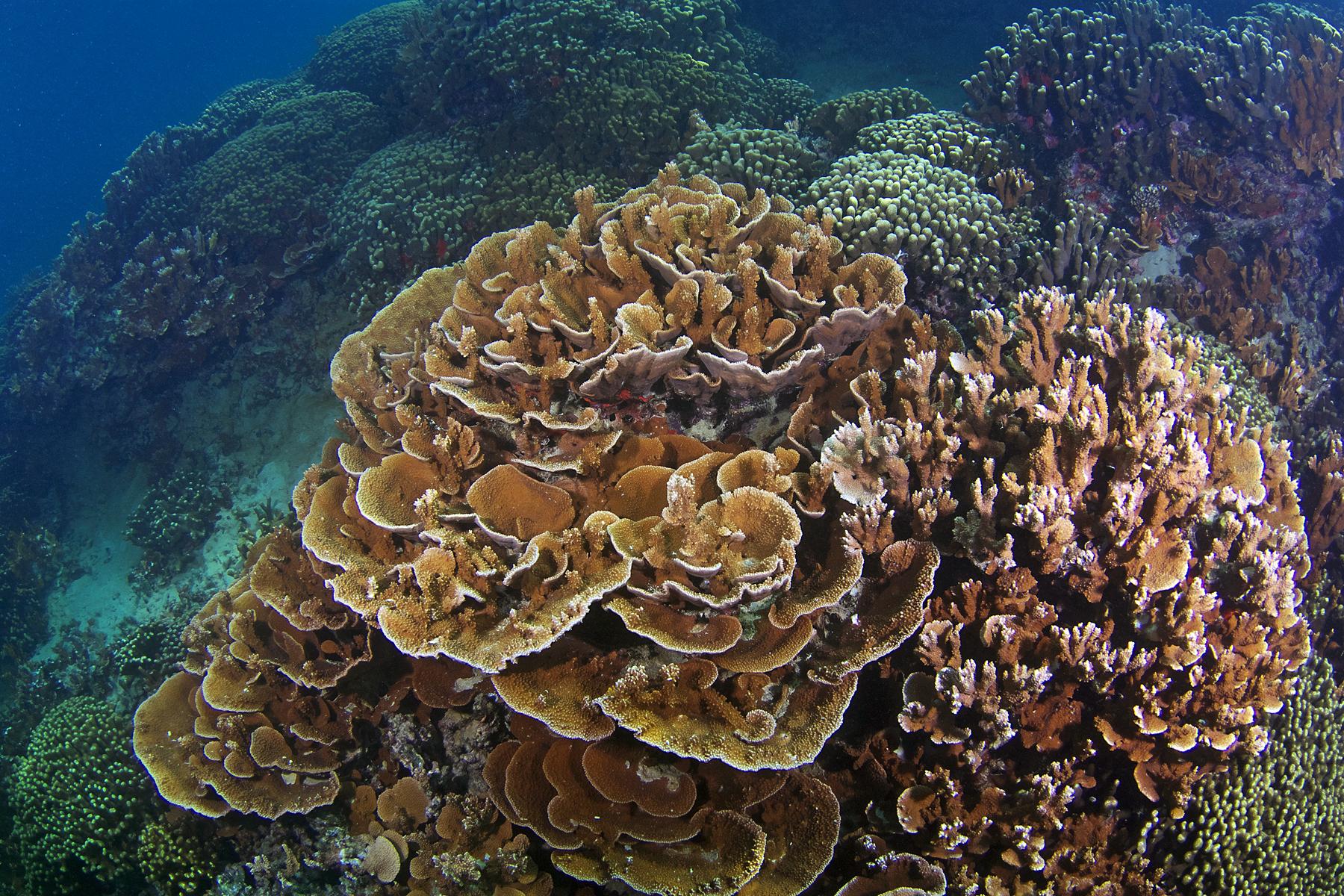
Montipora capitata · Rice Coral

M. capitata reef, UHM Polyp Pod field footage
Background

Reef sounds are maps of habitat information

Acoustic enrichment can influence settlement

Our multi year study found that acoustic enrichment and artificial habitats influenced larvae recruitment and settlement, within 20 m of the playback source.

Coral larvae actively use acoustic and vibrational cues to navigate and settle.

Human-Reef Connection

We exist in a deeply symbiotic relationship with our reefs as biodiversity hotspots ~ and when immersed in water - where pressure waves travel ~6x more efficiently than in air, sound is a primary sensory modality for most organisms in the ocean.

It is our responsibility to understand how noise can mask and disrupt natural cues.

Call Type 1

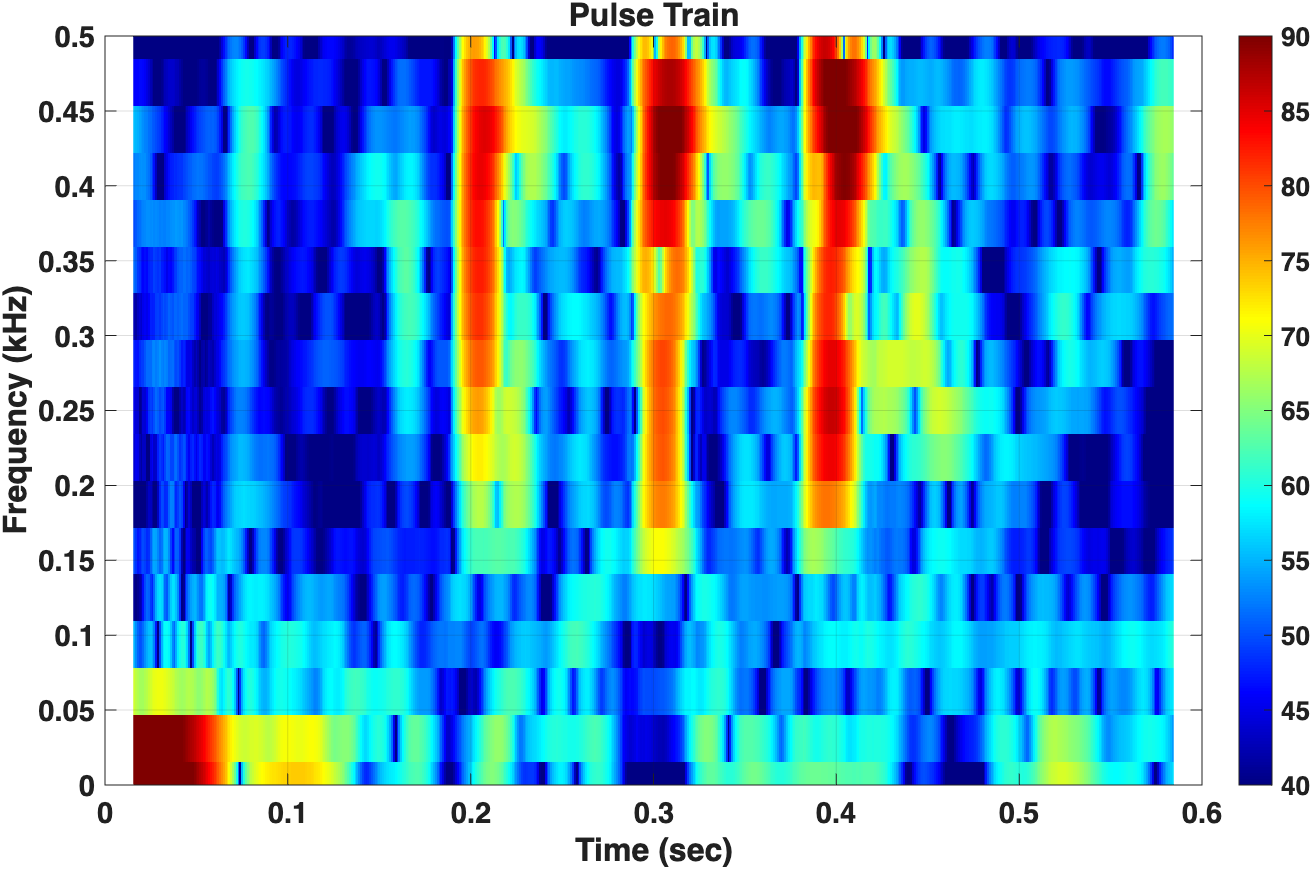
Pulse train call (damselfish)

Pulse train spectrogram from damselfish call

This spectrogram shows a repeating pulse-train call, often heard in damselfish territories. In this view, time runs left to right, and brighter bands show where sound energy is strongest.

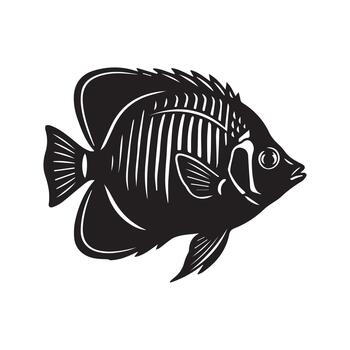
Damselfish silhouette

Hawaiian Damselfish

Call Type 2

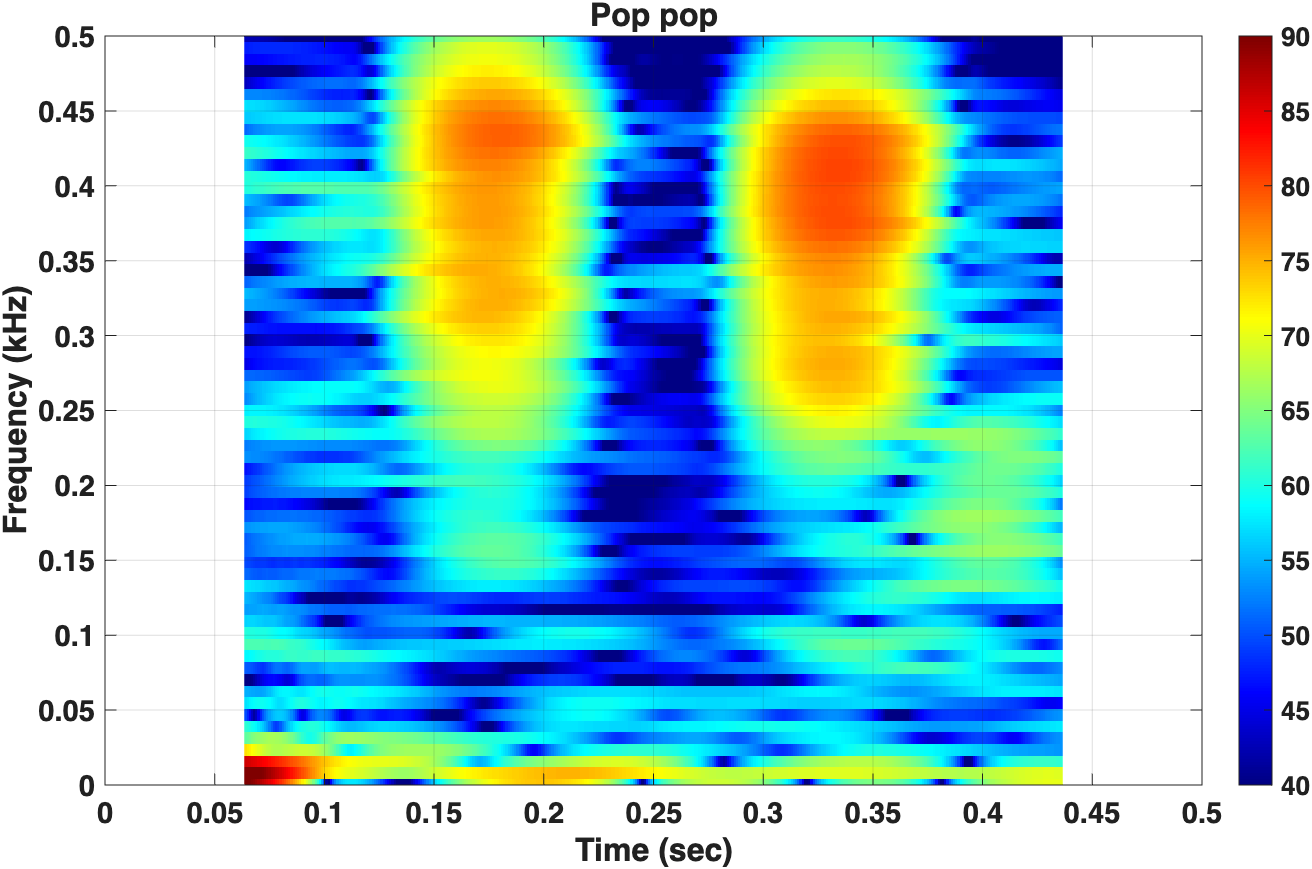
"Pop-pop" call (unknown reef fish)

Pop-pop spectrogram from unknown reef fish

This spectrogram captures short "pop-pop" bursts from an unidentified reef fish. These calls appear as compact vertical pulses, which can help us compare species behavior and habitat sound changes over time.

Unknown reef fish

Unknown reef fish

Meet the instrument

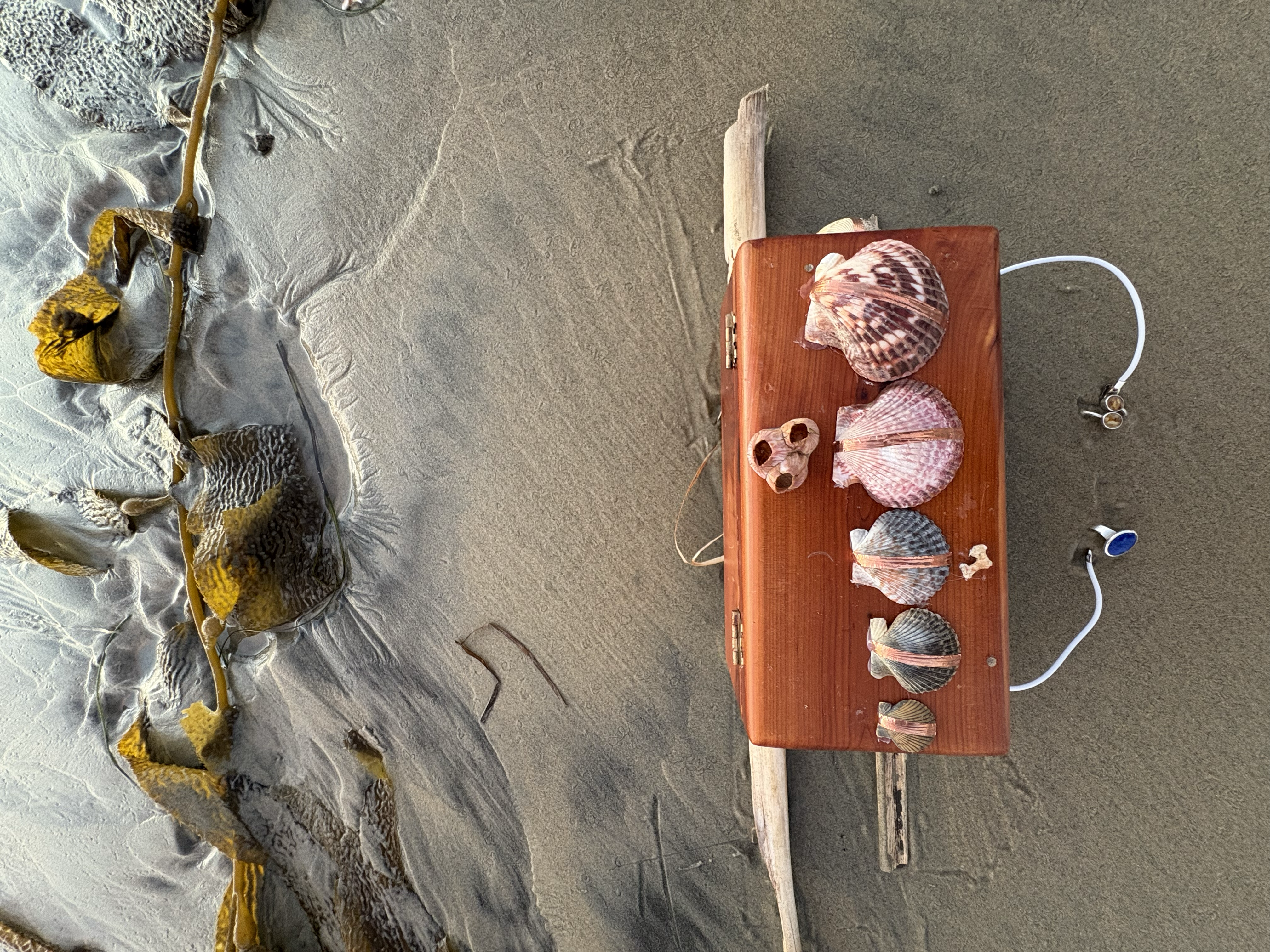
Shellfeggio Synthesizer

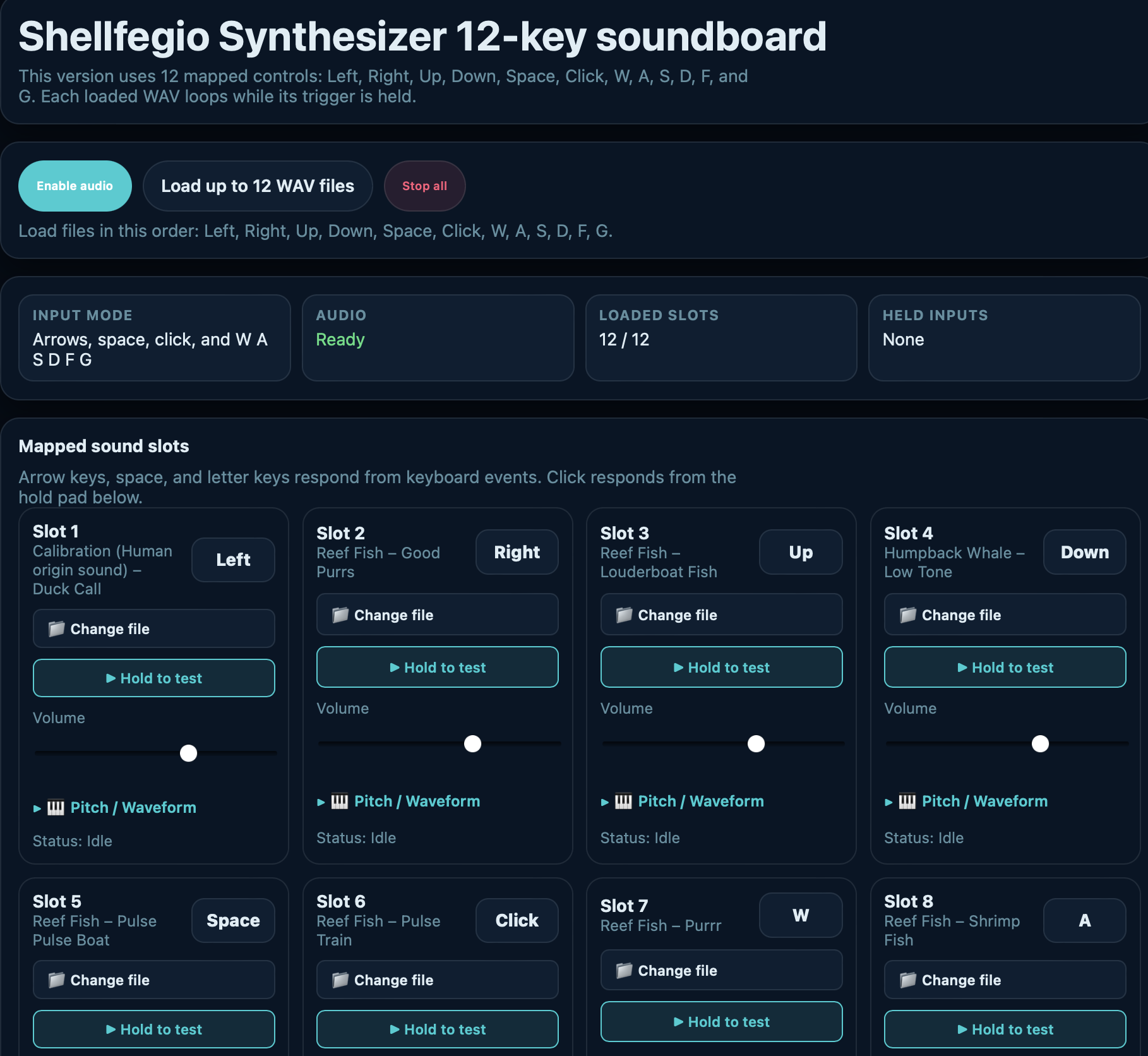
A modular, playful and open source interface for interacting with, creating and sharing a reef's soundscape — built so that anyone can experience and layer reef sounds from the field.

Interact — touch-triggered WAV playback direct tap and looping capacity

Create — per-slot pitch / waveform control; load any WAV to remap the soundscape in real time

Share — web browser based with offline cache; runs on any smart phone, tablet or desktop with no install required

Shellfegio soundboard interface Shellfeggio top view with kelp

Giving Our Reefs A Voice Above the Waves

1. Touch becomes listening

Touch and gesture become a point of entry to reef acoustics.

2. Playback becomes exploration

Participants explore fish choruses, shrimp snaps, and settlement cues as a responsive map.

3. Modulation reveals difference

Modulation reveals the difference between healthy and disrupted soundscapes.

4. Participation builds empathy

Participation links sound, habitat, and restoration.

Conclusion

Shellfeggio makes reef sound interactive, making us reef fish DJs!

Polyp Pod provides the form. Shellfeggio enables human–reef exchange rooted in ecological data and participatory play.

Sharing Science Differently
From acoustic enrichment field studies, settlement cues patterns, ecological acoustic data.
Accessible Interface
Shellfeggio synthesizer, touch, modulation, embodied listening, participatory play.
Outcome
A public encounter where restoration science is explained and activated through communal interaction.

Thank you  •  Mahalo

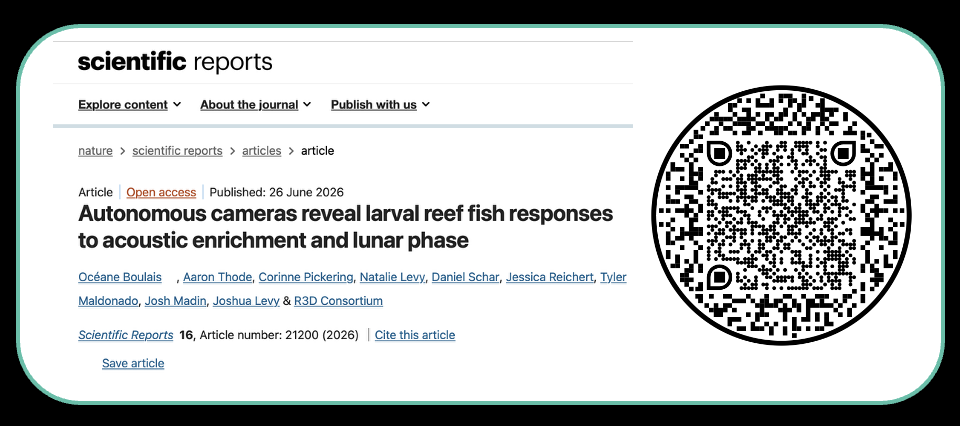
If interested in learning more about the Science behind the SciArt

Scientific Reports: Autonomous cameras reveal larval reef fish responses to acoustic enrichment and lunar phase Co-authors, affiliations and funding partners